
Available for primary schools to universities, libraries to museums, clubs to conferences, virtually and in person.
Space history:
Hidden Figures: The Women Pioneers of Space Science
Behind every giant leap forward in space is a woman–lots of them, in fact. In the mid-20th century, women were fundamental to NACA/NASA’s most significant projects. From Katherine Johnson to Nancy Grace Roman, come learn about the scientists and engineers who set the stage for humanity’s first steps into the cosmos…and why we need to fight to preserve their legacy.
Shattered dreams—or why Elon Musk isn’t taking us to Mars
You can hardly go a day without hearing about SpaceX, and the “Starship” that they are developing. The erratic Elon Musk promises much: weekly flights at a million bucks a pop; a colony on Mars; a lunar space station.
But can he deliver? And what is the competition up to? Nearly 60 years after the Moon landing, are we any closer to leaving our planet wholesale than we were in 1969?
Join space historian Gideon Marcus for an in-depth look at the current space industry, obstacles to advancement, and possibilities for the future.
The First Space Race: 1945 to 1957
Before Sputnik ever soared, the Cold War superpowers were already locked in a fierce competition. This two part course will detail the steps to space, from the V-2 to Vanguard, the Semyorka to Sputnik. Come not only for an exciting trip through American and Soviet rocket and spacecraft history, but also for insight into the future of space travel in the 21st Century!
Stepping stones to the Moon: Mercury and Vostok, Gemini and Voskhod
When President Kennedy boldly announced in 1961 that an American would be on the Moon “before this decade is out”, the United States still hadn’t even sent a man into orbit!
Join award-winning space historian and science fiction author Gideon Marcus for a tour of America’s first steps into space: the “spam in a can” Mercury missions and the more ambitious flights of Gemini, the two-seat spaceship that could, which paved the road to our celestial neighbor…and beyond!
The first giant leap: Robots to the Moon–Pioneers, Rangers, and Lunas
In 1957, the Soviet Union lay down the gauntlet of the Space Race with the launch of Sputnik 1. In less than a year, the United States was already sending probes toward the Moon. What ensued was a six-year competition fraught with failures, but capped by ultimate success for both sides.
Join award-winning SF author and space historian Gideon Marcus for a deep dive into the probes that made Neil Armstrong’s “one small step” possible.
Astronomy:
The life, and the afterlife, of stars
Did you know that nearly every star you see in the night sky is in its death throes? Or that the pretty nebulae in our favorite sky photos are really stellar nurseries? Before the Sun became the benevolent bringer of warmth and energy, it was a turbulent disc of gas; when it runs out of fuel, it will become a bomb on a cosmic scale. And that’s, in many ways, just the beginning of the story…
Join historian and science fiction author Gideon Marcus for a jaunt through the birth, life, and life after death of all that twinkles in the sky.
Strange New Worlds: How we discovered the planets beyond our solar system, and the exotic secrets they hold
From seven worlds to seven thousand: the last three decades have been the most exciting in the history of planetary astronomy. How do scientists peer dozens–or thousands–of light years away to make out solar systems around distant stars? How do these systems differ (and compare) to ours? What revelations about planetary formation, alien atmospheres, and the possibility of extraterrestrial life have these discoveries produced? Enroll in this whirlwind survey course to find out!
The coolest planets…are moons: The exotic worlds of Europa, Enceladus, and Titan
When we were growing up, there were exactly nine planets, and they got all the love. But it turns out the most interesting worlds nearby, the ones with oceans and the highest potential for harboring life… orbit around those planets.
Join space enthusiast Gideon Marcus for a discussion of the most exciting celestial bodies in the solar systems: all of them moons
E.T. Where are You? Hunting for aliens in the stars
Star Trek and Star Wars taught us that the universe was teeming with aliens… but where are they? And how would we recognize them if we saw them?
Join space historian and science fiction author Gideon Marcus for a class on the search for extraterrestrial life—and what it will mean when we find it!
General science:
What Science Fiction got wrong…and right—(and how you make the future)
In the 1950s and ’60s, scientists and engineers were hailed as saints of progress. People believed that technology would solve all of the world’s problems.
But the science fiction and mainstream prognosticators of the same era also foresaw technology causing the world’s imminent end: by nuclear war, overpopulation, global unemployment, environmental catastrophe … and plague.
How accurate were the futurists and science fictioneers of the last century? What predictions didn’t materialize, and what visions may yet come true? And do we, today, have the ability to change tomorrow?
The Lost Continent(s): Atlantis, Mu, and More!
Once, far beyond the sea, supposedly rose the towers of ancient civilizations far in advance of ours. These lands still ring in our consciousness: Atlantis, Lemuria, Mu. Are they flights of fancy, or are they echoes of real prehistory?
Join historian and science fiction author Gideon Marcus for a look at the most famous sunken continents, where they came from, and how real they might have been.
Hoaxes and Hominids: a history of the history of the tool-using ape
Darwin’s The Descent of Man tied human evolution with that of all other creatures. But just how did humanity come to be, and who…or what… were our direct ancestors? It took more than a century, and a lot of chasing down blind alleys, for that hotly debated question to be definitively settled—and we’re still refining the answer!
Join historian and science fiction author Gideon Marcus for a quick tour of hominid evolution, how we came to understand it, and what took us so long.
When Dinosaurs Ruled the Earth
For more than 150 million years, the dinosaurs reigned supreme. Now they’re all gone… or are they? Because the plodding, moronic “terrible lizards” were actually warm-blooded, hardy creatures, and their descendants visit our feeders, whistle from cages, and steal our picnic lunches.
Join historian and author Gideon Marcus for a history of these magnificent creatures, what lay them low 65 million years ago, and how they’ve since flourished.
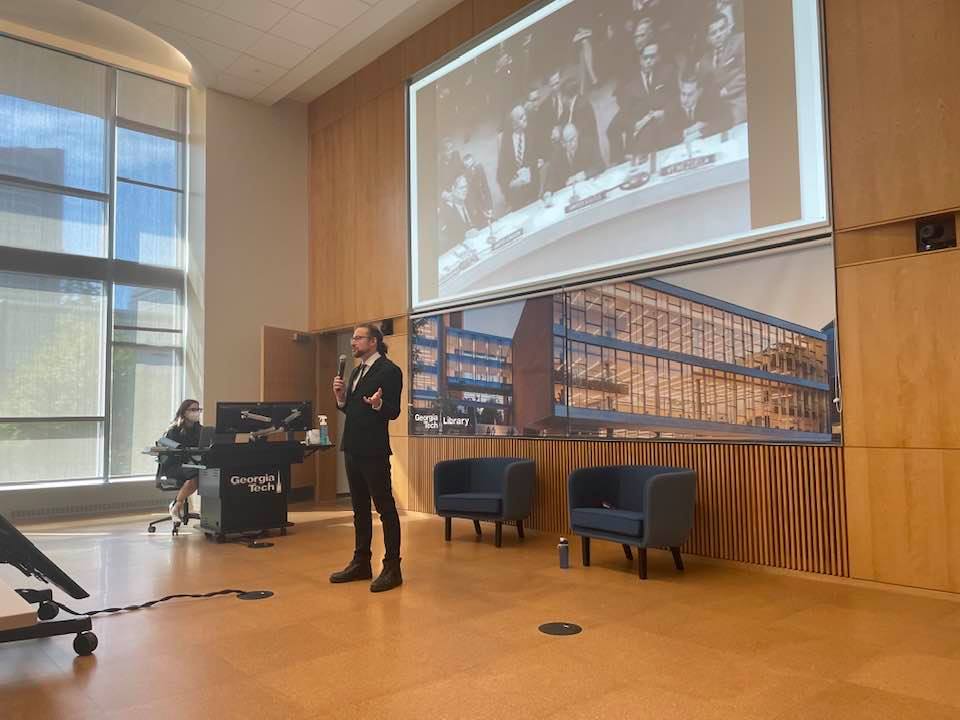
Engagements beyond the San Diego/Los Angeles/Inland Empire megalopolis will require a flight. Speaker’s fee is negotiable based on travel time and distance (particularly with non-profit or educational institutions). Travel and lodging expenses are expected to be covered, as needed.
Fill out the form below to reach me!

“>